Tuesday, October 31, 2006

I am playing with the idea of making images which look like objects, but they are actually paintings... I mean, a picture of a painting...

Unconcious Painting on Black, 2006.

(Photograph of an objectified painting).


1.1 Images of Resemblance:Magritte's semiotic explorations
What one must paint is the image of resemblance—if thought is to become visible in the world.
—Rene Magritte


Magritte was not making a primer in semiotics: he was making art of the special, modern, "meta" kind which deautomatizes the conventionalized and makes us aware of the processes by which we see and read the world. His probing of seeing and grasping, to be sure, is general and philosophical, almost Kantian, in its insistence and rigor, and it is easy to see why Michel Foucault was intrigued enough to write a short book in 1973 on the multiple readings and cancellations of "This is not a Pipe," 5 and why Magritte would see in Foucault's Mots et Choses both a familiar title and a sweeping scope of inquiry similar in spirit to his own "research."

Magritte has become much more readable—his mode of thinking and working more mainstream—as Conceptualism and Poststructuralism have moved visual art so much closer to language and philosophy than it was under High Modernism. Thus Peter Sterckx articulates Magritte's experiments in representing representation along lines similar to those developed here by describing them as working out the rhetorical scheme of syllepsis (one construction changing into another). 6 Such a move would seem to a Modernist extravagantly metaphorical and muddled, though it does not seem so today. Interest in representation is now much more widespread than it was in Magritte's time, but we will take him as a pioneer and begin by tracing his experiments with words inside the frame of the picture and then with words placed outside (above or below) the frame as titles.
GEORGES ROUSSE


FIRST OF ALL, CONGRATULATION TO YOU PAULA FOR YOUR EXHIBITION IN ZURICH!
THE WEEK HAS PASSED QUITE QUICKLY, BUT I HAVE BEEN LOOKING AT SOME PHILOSOPHER AND ARTISTS ABOUT THE LANGUAGE OF THE IMAGES IN RELATION TO THE "TRUTH" OF REALITY.
I FOUND AMAZING THE CHAPTER 3 "RHETORIC", WHERE AT PAGE 34 DERRIDA SAYS THAT "THERE IS NOT ONE SINGLE HISTORY...BUT RATHER HISTORIES".
BASED ON HIS THEORY THAT REALITY IS ALWAYS AN EFFECT OF HOW IT IS REPRESENTED, INTERPRETED AND DISTORTED, HE ALSO SAYS THAT "WE NEED TO INTERPRET INTERPRETATIONS MORE THAN TO INTERPRET THINGS".
HE QUESTIONS THE PRINCIPLE OF MIMESIS, THEREFORE THERE IS NOT A REALITY PRESENTED TO US VIA LANGUAGEW OR IMAGES, IT CAN ONLY BE A REPRESENTATION!!!!!!!!!!
AT THIS POINT I AM GETTING VERY EXCITED. MY WHOLE RESEARCH AND QUESTIONS ABOUT WHAT IS REAL START TAKING SHAPE.
I FOUND A VERY INTERESTING CHAPTER ON A BOOK CALLED PHILOSOPHY OF THE ARTS, BY GORDON GRAHAM. THE CHAPTER IS CALLED IMMAGINATION AND EXPERIENCE pg62.
HE TALKS ABOUT THE DIFFERENCE BETWEEN A MAP AND A PHOTO...WHICH ONE IS REAL? THE PHOTO CAN BE MORE UNREAL THAN THE MAP, AS A MATTER OF FACT IT CAN NOT TAKE YOU IN A GIVEN POINT, IT IS AN ITERPRETATION OF THE PHOTOGRAPHER. THE MAP, BEING GRAPHIC AND NOWHERE NEAR TO THE VISUAL WAY OF PERCEPTION OF THE "REAL" PLACE, IS STILL ABLE TO TAKE YOU "THERE".
BUT APART FROM QUESTIONING THE NATURE OF THE PHOTOGRAPH, I HAVE BEEN LOOKING AT OTHER POSSIBILITIES OF THE MEDIUM... NOT ONLY LIES, BUT ALSO THE POSSIBILITY OF SOME FORM OF METACOMMUNICATION OR EVEN SPIRITUAL MESSAGE BEYOND THE VISIBLE...
HEGEL FOR EXAMPLE SAYS GREAT THINGS ABOUT THE SPIRITUALITY OF THE ARTS...
(TO BE CONTINUED...)

Thursday, October 26, 2006


What is this poster there for? What is it saying? Why?
Why do i need to know that "WE ARE LONDONERS?" "WE ARE ONE" also?
Considering the cost of the advertising, printing etc. why bother filling the whole city with this statement? Who does it need to remind, or telling that? WHY?!?!?!?!?!??!?!?!
OK there is a sponsor name in the bottom left corner, who probably pays for the costs, but, why such a propagandistic old fashion kind of slogan?
I can only think of one thing: to create, or mantain a sense of belonging to a group, to being part of something and to make feel the reader proud of, more or less conciously.
In case of terrorist attack, or also while rising council taxes or transports fees, for example is this poster trying to say that after all the trouble we are "One", therefore struggling toghether we might feel a kind of relief? Let's notice that in the bottom right corner it also says "Mayor of London"...!
THIS IS THE KIND OF PHOTOGRAPHY I HAVE BEENG DOING RECENTLY. I AM TRYING TO MAKE IMAGES WHICH QUESTION ABOUT THEIR OWN NATURE...
PERCEPTION? METAPHISICAL? PRESENCE BEYOND WHAT
I SEE?


QUESTION: WICH ONE OF THESE 3 PICTURES IS THE REAL TOWER BRIDGE?

ANSWER: NONE. WE LOOK AT REPRESENTATION, NOT AT THE REAL BRIDGE.

SURE ENOUGH, THE TRAVEL AGENT WON'T USE THE THIRD ONE TO ADVERTISE ITS TRAVEL PACKAGE. IF WE NEED TO KNOW HOW TO GET THERE WE DON'T WANT THE FIRST ONE, BUT WE ALL EXPECT TO SEE IT LIKE THAT AFTER WE SPENT THE MONEY FOR OUR TRIP TO LONDON.

WHAT WE SEE, WHAT WE PERCEIVE, WHATR WE EXPECT. THE PERCEPTION OF REALITY IS FLEXIBLE ALSO ACCORDING TO OUR MOOD. WHAT AFFECTS US IS ALSO AFFECTS OUR PERCEPTION.

(SEE ALSO PHENOMENOLOGY OF PERCEPTION, MAURICE MERLOU-PONTY.)

"SPIRIT DOES NOT STOP AT THE MERE APPREHENSION OF THE EXTERNAL WORLD BY SIGHT AND HEARING; IT MAKES INTO AN OBJECT FOR ITS INNER BEING WHICH THEN IN ITSELF DRIVEN, ONCE AGAIN IN THE FORM OF SENSUOUSNESS, TO REALIZE ITSELF IN THINGS, AND RELATES ITSELF TO THEM AS DESIRE". ( HEGEL'S INTRODUCTION TO AESTHETICS PG 36).

ANOTHER CORNERSTONE FOR MY RESEARCH
(JAQUES DERRIDA)"...QUESTIONS THE PRINCIPLE OF MIMESIS BY STRESSING THAT REALITY IS ALWAYS AN EFFECT OF HOW IT IS REPRESENTED, INTERPRETED AND DISTOTED. WHEN WE THINK WE ARE LOOKING AT A FAITHFUL REFLECTION OF REALITY, WE ARE ACTUALLY DEALING WITH AN INTERPRETATION OF REALITY.
HENCE, "WE NEED TO INTERPRET INTERPRETATIONS MORE THAN INTERPRET THINGS". (CRITICAL AND CULTURAL THEORY, D. CAVALLARO, PAG 34).


THESE ARE 3 EXAMPLES OF FISHLI & WEISS WORK WHERE THE COMMON ELEMENT IS THE CONSTRUCTION OF THE REALITY. WHILE IN THE SECOND AND THE THIRD PICTURE THE CONSTRUCTION APPEAR OBVIOUS, THE FIRST ONE, (THE TIRE), IS ALMOST IMPOSSIBLE TO SEE, EVEN IN FRONT OF THE ACTUAL OBJECT, THAT IT IS MADE OF POLYSTYRE, THEREFORE NOT A REAL TYRE...
THESE EXAMPLES AND THE EXHIBITION VISITED AT THE TATE HAVE BEEN CORNERSTONES FOR MY RESEARCH ABOUT REALITY.

Today has been an important day for my research.I went to the Fishli & Weiss exhibition and i discovered how their work is strongly related with my researche topic. the construction of reality and the use of vary medium made me wanting to explore more in the meaning-message and language of the work of art.also an important lecture and reading material has come from Paula's theory lecture.Sign, language, rhetoric appear to the surface of any image-object in the natural and man made world.The excitement starts with the exploration on "how to make sense", how to get the message across, how it can be read...HOW?????????

This is an image i created last year... the constructed reality of 2 medium combined toghether,(mini installation with painting), rendered into a photograph.

Monday, October 23, 2006

Lauro Govoni
MA Art and Media Practice (Full time)

Project Proposal

A Journey into Perceptions searching for the Invisible


The project I am working on is based on how human perceptions work in relation to the visible world, how images are read and inhabit our reality.
Consequently I am interested to explore how physical images might reveal more of the metaphysical world through their visual language.
The aim of my project is to question that part of reality shaped by images, and more or less believed as real, with the construction of pictures which doubt their own nature.
This is part of an ongoing process started few years ago, during my BA Fine art studies. But even before, in everyday life, the search of a “different truth” had already
started looking at how the media present their messages, how different people interpret events in different ways, and how advertising images populate our environment, for example.

For this project I intend to try as many different medium and technique as I possibly can. I will use medium that I am not familiar with, (like video and animation). Experimenting I will try to see how different the message can be read, according to the language of the material, but also to let the mistake of the exploration process to reveal the unexpected with the possibility of creating new ideas.

At this point I don’t have a clear idea about a final form or presentation of my work, but I am thinking of a 2D kind of work presented possibly in a large scale which involves the use of more than one medium.
So far I have been gathering material related to my personal interest. The majority of my research has been done through philosophy and art history, but also looking at contemporary art and media events, and the diffusion of commercial images.
For my researches I need to look more into the contemporary art and critical debates, the technical aspects of the media, and also at the relation between art and the global economy.
To do so I think I will need to develop a research method which goes beyond the library type, (and the lectures I am taking at the moment just start to broaden the possibility), also to acquire more skills in video, painting and possibly animation techniques, and to improve technical and intellectual practices.

Undertaking this project I am working experimentally hoping to develop a more personal style of art-making with a broader knowledge of the cultural and intellectual context.
Through teaching tutorial and group work, but also from external viewer’s feedback, I will try to analyze to what extent I have been more or less successful in communicating and developing concepts and ideas related to my practical work.

Friday, October 20, 2006


THINKING RHETORIC

this is one of my recent work. i am calling it experiment.
what do i read here? a photo of a painting with a pencil on top?
actually no. it s a montage of a painting, a canvas and a pencil. all photos. but if i print the whole picture on canvas i will read it as a painting with a "foreign body" on top, (pencil), wich it looks as if a photograph is stuck onto a painting...

Thursday, October 19, 2006


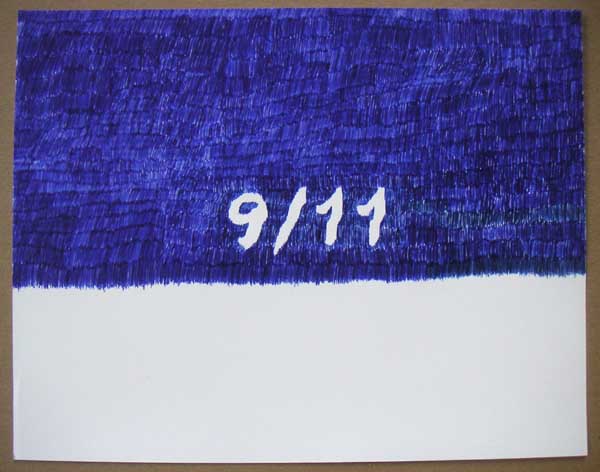
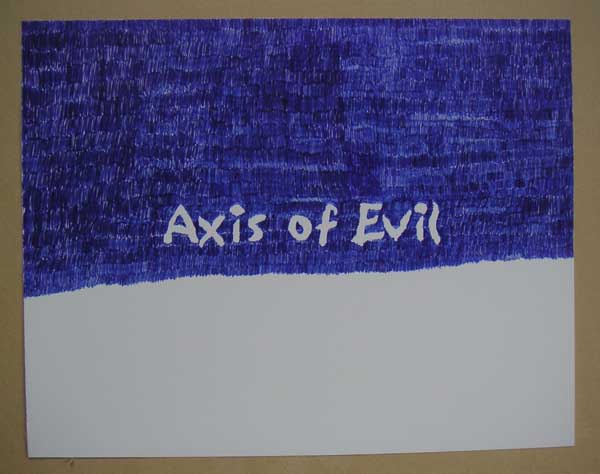
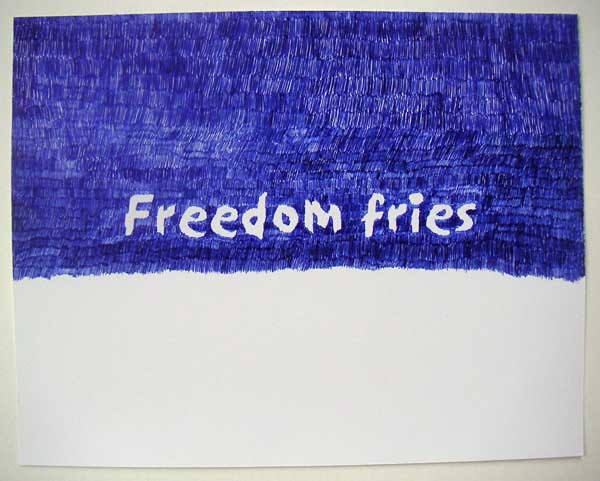
drawings or texts? or both?
where is the line between an image and a text? they are both signs.
these drawings by Rainer Ganahl make me question what i am looking at...
Are they telling me something against or in favor of Bush?

The White House restaurant discontinued serving French wine and so-called French Fries where renamed: Freedom fries.


http://http://www.ganahl.info/don_t.html

this looks like a really good example of image-sign- rhetoric...
considering what happened after 9/11 and the speaches of the president Bush.
the pictures we see everyday contain way more than what we think.
a sarcastic italian joke says, to someone who is illiterate, that he carries a newspaper with him, pretending to belong to a reader category, but he can actually onlyREAD pictures...
actually reading pictures is probably something more complicate than reading texts.
this is where semiotics explains the whole intellectual practice of reading, through signifier and signified, denotation and connotation and so on.

what can we say looking at the picture released few days ago about the "assassination of George Bush"? advertising for a tv show, of course. but what other meaning does it carry?
fantasizing about an event using the codes of photojournalism, (black and white), with reference to other real assassination and attempt of assassination (president Reagan, president Kennedy, ML King, etc.) through the use of composition, consrtuction of visual language.
looking at structuralist theory we can see in fact how these codes are used to reach people minds.
structuralism is concerned with a universal kind of language where signs and images are able to reach everyone through a mental process based on common experiences expressed symbolically.
although the structuralism has been argued by the poststructuralist theory, saying that the language does not use universal structures and the nature of language is shifting constantly,
the example given by the picture of the assassination og G. Bush seems to work very well.
the codes of the picture are well recognizable by the western reader due to his past experience in "reading" this kind of images of past events associating them with the present one.

what is this picture (and tv show) created for? fantasizing? catharsis?
this goes very well with roland barthes mith...
this is interesting...what is this picture for? fantasizing?
this is the poster.
after seeing the movie it is great to read about the creation of myth with images, as roland barthes says in his example of peris-match magazine. (see article on web page) http://www.aber.ac.uk/media/Documents/S4B/sem06.html

Wednesday, October 18, 2006